Ruptural strategic shifts towards Democratic Control of Technology

People have seen empires come and go. These times are not special. When an empire crumbles, the political game splits between accelerating the process, protecting the most vulnerable from the falling debris, and starting to plan for what comes next.
New formations revolving around technology redefine the contour of the political arena: Effective Altruism, Accelerationists, Neo-Luddites, Doomsday cults, AI worshippers, Tech Monarchists, Hardline Primitivists.
History moves again.
Politics is back.
Tech Workers join the frail.
We have a whole future to win.
Introduction
I’ve just finished reading “All In: A Revolutionary Theory to Stop Climate Collapse,” and I’ve been positively surprised by its ambition. The book frames a specific approach to strategy development for the environmental movement, then generalizes it to a strategy to rupture the entire political system. It starts from the premise that science sets a very clear deadline, a few years from now, before irreversible catastrophic chain reactions will jeopardize the survival of the majority of the human population. The target outcome is the establishment of a different path in which emissions reach 0 by around 2030. The main strategic frame passes through disarming capitalism in the span of a few years. From this, follow several strategic conclusions which I won’t recapitulate here.
The clock is ticking for everybody.
The book tries to be as critical as possible towards the existing strategies and organizations of the environmental movement, including the ones the authors supported. This is done to push forward a plurality of approaches, rather than proposing a single, unitary new strategy. Such an approach, called occasionally “movement ecology”, is complemented with an organizational materialist perspective, i.e. the idea that the transformation of the material and social world is driven primarily by the development of organizational capacities. Politics as a conflict of organized forces rather than a conflict of ideas.
I think it’s easy to appreciate the bold proposition behind the “movement intervention” the book represents, and the attempt at condensing into specific, actionable recommendations for the environmental movement what is the new “organizational common sense” built on systems theory, Nunes’ political ecology digested through Ulex’s educational program, and the lived practice of organizational experimentation that sets environmentalists apart from most other political spaces, at least in Europe.
Now, if “All In” doesn’t sound ambitious enough, in this piece, I will try to repeat the same exercise for the Western Tech Workers Movement, in a single paper. It is still an “intervention from within”, even though, given the differences between the current state of the environmental movement and the Tech Workers Movement, mine will be less dramatic and more focused on expanding the horizon of what has to be tried.
Methodology
Let’s narrow down the scope of our exercise:
– Targets of coordination: the western Tech Workers Movement, understood as that portion of the labor movement aware of the necessity of organizing tech workers according to their own specificities. This means labor organizations such as unions, union confederations, workers’ collectives and communities, cooperatives, and labor NGOs active within or around tech companies. The focus of the article is on the USA and European context, the one I know the best, but not necessarily restricted to it.
– Winning condition: tech labor becoming a primary force pushing for Democratic Control of Technology (DeCoTech), understood as the historical project of wrestling technological production, maintenance, and governance away from Capital to be put in control and service of new democratic counter-institutions. It is understood as a general political direction to pick provisional and context-specific, rather than fixed and universal, goals. DeCoTech is a profound restructuring of societal structure to integrate the control of digital technology into new institutions and forms of worker power. It is distinct from the current, often technocratic, efforts to reform existing institutions of liberal democracies to coexist with corporate control of technology.
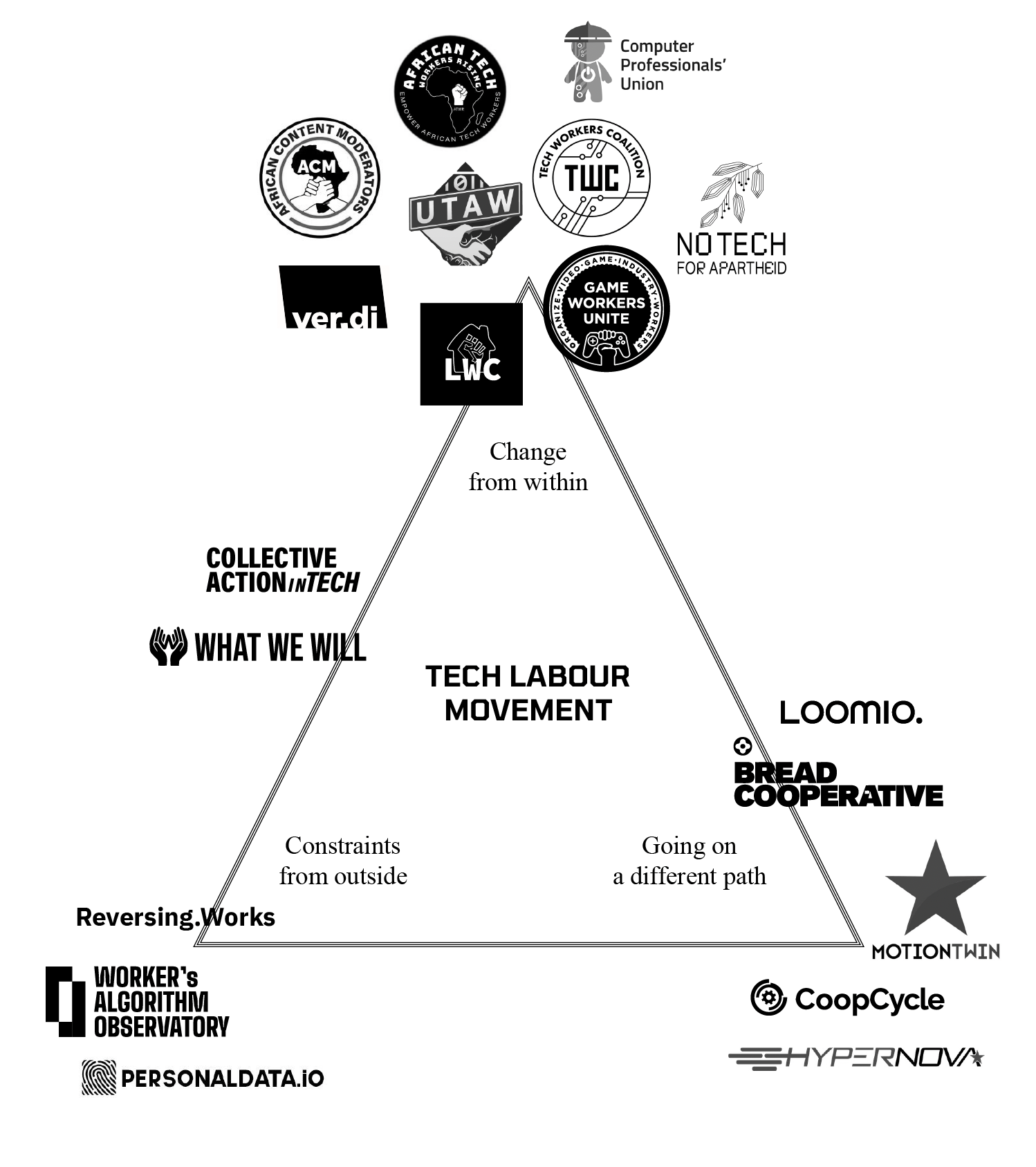
Fig. 1 A sample of organizations in the Tech Labor Movement, organized by their point of leverage.
• Within the industry: unions, workers collectives.
• Outside the industry: NGOs, Research Groups, Institutions.
• Alternative path: co-ops
As principles of good strategic development, we will employ the following criteria:
– Capacity Building over Outcome Delivery: the goal of strategic alignment must not be the convergence on a singular desired outcome, a singular coordinated organization, or a single hegemonic ideology, but the increase of the power to act of the whole tech labor ecosystem. This must match in size the power to act of the tech industry and its allies. We start from the perspective that Power sits in the affordances offered to individuals and organizations, rather than within specific decisions or the fulfilling of goals.
– Functional Diversification: A healthy political ecosystem must see all its critical functions covered, and ideally covered by a plurality of organizations with a plurality of approaches. Functions that are missing must be proactively filled, and organizations attempting to cover too many functions at once should be helped to find strategic focus.
– Strategic diversification: We must assume no single person or organization has the right approach. We all believe ours is correct and that’s why we commit to it, but the long-term effectiveness of a political strategy can truly be assessed only in retrospect. Strategic alignment is not to agree on a single strategy to bet all our resources on, but to allow each organization to position itself in a way that their betting is not detrimental to other organizations with shared values and shared vision, but different ways to execute such vision. Strategy development becomes a way to maximize the acquisition of energy within the political ecosystem and its distribution to cover as many approaches, experiments, and scenarios as possible. Successful formulas that can demonstrate consistent impact and success will organically attract more resources in the long run.
Following these principles, the article is structured around four main sections:
– Context: where we are standing.
– Capacity Building: how to activate people and expand our agency.
– Functional Diversification: how to employ agency differently to build more power.
– Strategic Diversification: what this power should be spent on to achieve deeper change.
The Current Context
Before moving to our strategic analysis, let’s take a moment to observe where the tech workers movement is at right now and what’s around us.
Following a commonplace narrative, I conceive the Tech Workers Movement as developing around the early ‘00, when the first IT companies started seeing dedicated efforts to form unions. This follows several decades in which very few IT companies, such as IBM, saw consistent forms of workers’ representation, but without much attention to the specificity of the tech sector, let alone a vision of unionizing the whole sector. Some countries, such as Argentina, Romania, or the Philippines, saw the creation of early IT-specific unions, sometimes with good success in their local context. These experiences often followed the patterns of their local union ecosystem, applying proven formulas to a new sector, but with limited narrative power and global political ambitions.
A note on naming: in the scope of this article, we will use the term “Tech Workers Movement” to refer to the system that perceives and narrates itself as a coherent entity within the broader and fragmented world that exists at the intersection of technology and labor, which we label “Tech Labor Movement”. We understand the Tech Labor Movement as the pro-worker portion of the total “movement ecology” surrounding the Tech Workers Movement. The two terms are colloquially used interchangeably, but we use them as rigorous labels for the sake of this article.
The Tech Workers Movement saw very asymmetric moments of acceleration in different countries, but it’s unambiguous to say that 2016-2020 was the period in which the possibility of organizing tech workers became a realistic narrative in the Global North thanks to the first protests at Google or Microsoft, the unionization of Kickstarter, and many more subsequent mediatized union drives. This includes cases like the global unionization efforts of Amazon, proceeding unevenly across countries, but still reinforcing the idea that tech companies can be challenged from within. The USA portion of this history is well recounted in the book Against Tech Oligarchy.
Now, in 2026, the tech workers movement has graduated from its infancy, in which the viability of organizing IT companies has been proven, either to improve working conditions or around political and ethical concerns. While some people still believe tech workers cannot be organized, it is now possible to just point to the headlines to prove them wrong.
Entering adulthood, the movement cannot be just content with being alive or experimenting with what’s possible. Labor organizing will become a more dangerous affair given the rising authoritarianism in several countries like the USA, Germany, Italy, and the UK. It is time to act on our ambitions and step into responsibility for the future of humanity.
The aforementioned book Against Tech Oligarchy presents a very compelling breakdown of the limits of the movement in the USA, in particular focusing on the complexity of using slow, low-conflict, structure-based organizing in companies working remotely with a high turnover. While these learnings cannot be easily generalized to the rest of the world, it is true that most struggles around the world are facing similar problems: we need to find new practices fitting the reality of the production process in tech companies. We also need to adapt our narratives beyond the simple enthusiastic advocacy for unions and collective action in a single workplace, often requiring a lot of work to bypass the Californian individualism. This includes developing a compelling theory of striking in the tech sector, an issue that I consider still open, despite an ever-increasing list of successful examples.
The last few years have seen a coordinated attack on the value of cognitive labor, and especially tech labor. First, a wave of orchestrated layoffs, then the RTO strategies, and now the blathering around AI. We agree with the Broligarchs on one thing: tech workers hold a lot of power due to their position, and this is a problem for the tech elites.
The tech labor movement sits in a window of maximum urgency.
On one side, the power due to our position in the productive process is being reduced. The real bet of the AI edgelords is the possibility of definitely annihilating the need for cognitive workers. They call it AGI, but what they are really talking about is you doing work for free and calling it a blessing from the God-Machine. While these days the hope for AGI is vanishing, the Overton Window has shifted enough. The Cogsuckers are content to settle for making office workers as precarious and replaceable as a slave-worker in an American for-profit prison.
On the other side, this onslaught is finally motivating tech workers to organize. We saw it coming, and we have built structures to capture this energy. Nonetheless, it’s still but a small fraction of what’s possible and necessary.
Capacity Building
The capacity of a movement is primarily accounted for in terms of people, their connections, and their skills, from which economic power, knowledge power, operative power, and other forms of political power are ultimately derived.
If the Tech Workers Movement went from zero to one, it must now scale its capacity, build alliances, and be able to leverage forces to match the Capitalist power in the Tech industry. That means activating, in the next few years, workers around the world in the order of several million across types of organizations (unions, collectives, cooperatives, NGOs) and levels of activation. Anything less will fail to provide the resources necessary for any kind of ruptural change.
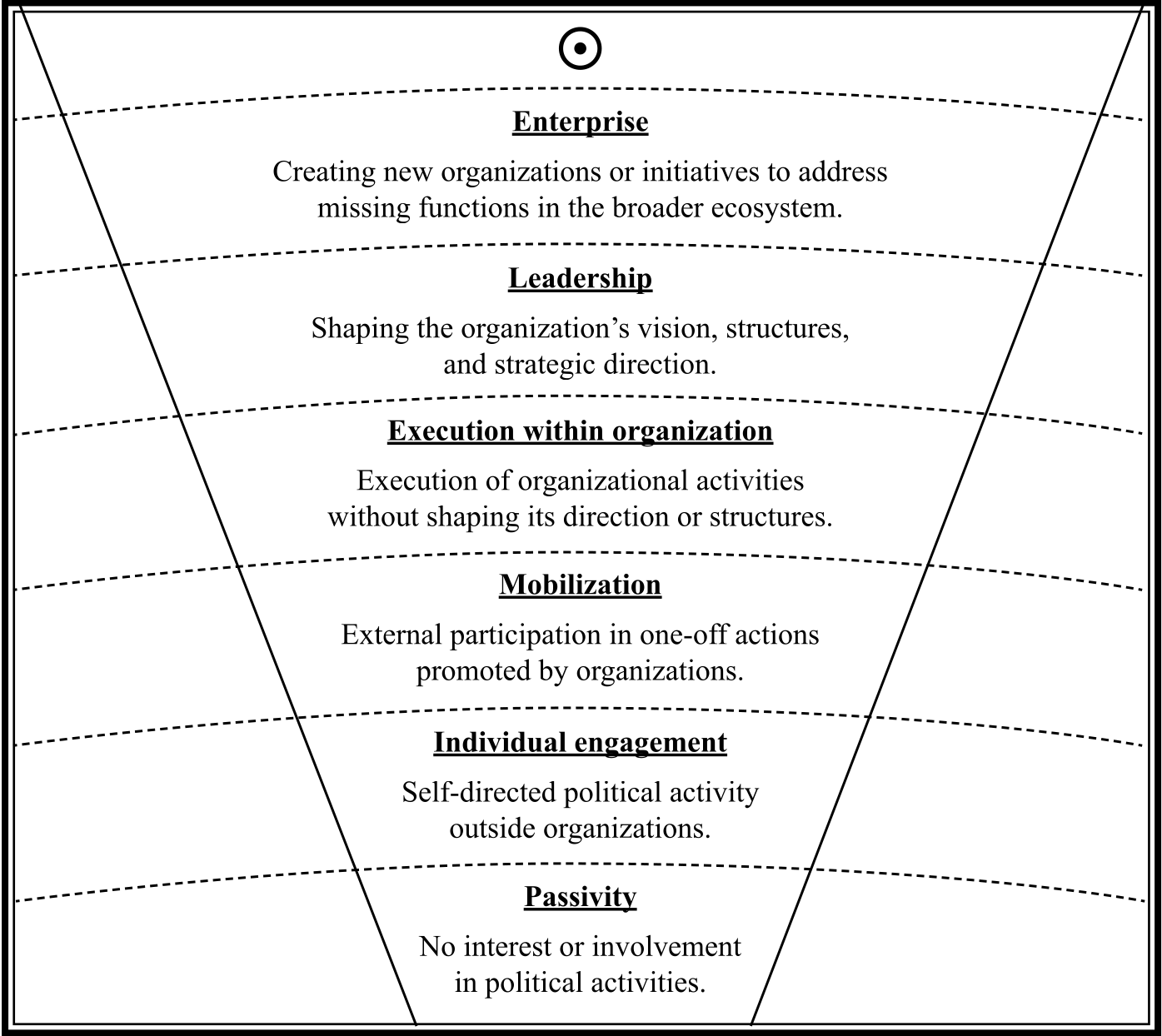
Fig 2. Levels of political activation
To conceptualize this pipeline, let’s adopt the framework showed in Figure 2. The goal is to expand the throughput of workers, going from reduced levels of activation (bottom) to increased levels of activation (top).
Each step requires organizations to implement different improvements at the ecosystemic level to be able to support people at different points in their activation journey. Let’s explore some of them.
Mobilization: while the situation in the last ten years has improved considerably, the tech labor movement still lacks cultural and media power. Joining a union or protesting a contract within your company is now a realistic proposition, but it’s far from being considered the norm, both by tech workers and people outside the industry. This must change. We have won isolated struggles within individual companies that, while setting important precedents, fail to portray the Tech Workers Movement as a phenomenon involving the totality of tech workers. While I’m very critical of street protest and mass mobilization without winnable demands, a practice overused and ritualized into irrelevance in many contexts, the complete absence of a tech worker mass mobilization is equally disempowering.
Mass mobilization, maybe in support of a specific strike in a well-known tech company, is a necessary narrative device to shift the perception of what’s “normal” for tech workers, and the new normal must be political and union engagement. On top of that, mobilization practices create social infrastructure for the radicalization and activation of workers beyond the single company, which now must go through online channels or the infrastructure of other political spaces.
A practical, actionable option is to build in cities with high absolute numbers of tech workers the infrastructure to call for mass physical presence in support of specific strikes, court hearings, or other events in which isolated struggles can be turned into a collective ritual. The goal is not to sell the idea that public pressure still works, but to test which narratives and networks have mobilization power, contextually to be turned into recruitment opportunities for local organizations. Heads must be counted, and muscles must be flexed.
We will explore this aspect from a functional perspective in the next section.
Execution within organizations: the second step of activation is what most political areas are struggling with in recent decades. It is not easy to move people away from understanding politics as centered around debate, opinions, awareness, and dissent towards instead as a practice rooted in action, impact, and change. Luckily for us, the labor movement in general and the culture of the IT sector focused on building give us an advantage.
Standardized workplace organizing training and processes with support from traditional unions are today the main gateway to active contribution. Beyond that, the ecosystem lacks scalable practices like the different forms of action from large-scale environmental organizations like Extinction Rebellion or Last Generation. The tech fraction of the BDS movement is offering a way to protest individual contracts within your company, but the barrier to engagement, on top of the inevitable repression risks, is still too high.
The movement must develop more accessible intermediary practices to cater to the many workers without experience or peers involved in organizing.
What I believe was a major mistake in the past years within the Tech Workers Movement was the disregard for the desire to apply technical skills for political gains. For fear of reproducing techno-solutionism, or to flatten the movement identity over the preexisting hacker culture, the message to newcomers was always: “Don’t program, don’t design, don’t build. Focus on relational work, political education, organizing skills.” This proved transformative for many, including myself, but it was a frustrating proposition for most of those still on the fence. The tech sector as a whole is living a crisis of meaning like never before, and workers every day feel they are wasting their skills on useless activities. Wasting this sentiment is a mistake. The solution must be channeling, rather than dismissing, the sentiment into politically meaningful activities.
One virtuous example comes from the Nùcleo De Tecnologia of the Movimento de Trabalhadores Sem Teto. Being a major social movement with huge technological needs for their base, they are able to ingest a huge number of tech worker volunteers and put them to work on addressing such needs. This can include maintaining the infrastructure in their network of occupations and social kitchens, developing new tools such as work platforms, but it especially focuses on critical digital literacy. New volunteers are given educational material and are sent to the occupations to teach the base, often lacking basic understanding of technology, how to use specific software, maintain their infrastructure, and even learn how to program. The opening message to the prospective volunteers is: “Your skills matter, but must be applied in a radically different way to have a positive impact.” Only later comes the radicalization, the relational work, and the organizing.
Leadership: the term Leadership here is used in the Nunesian sense of a human force using their agency to construct order in an otherwise ever-decaying system. It’s the intentional choice to steer away from prescribed tracks dictated by inertia, and transform organizations, systems, and society in the desired direction.
Tech Workers Coalition Global, the organization I’m part of and for which I do strategic work, concluded that, in the current phase, the development of organizing leadership outside of unions is one of the weakest points in the ecosystem, and decided to allocate resources towards developing educational resources for people already involved in organizing.
At a bigger scale, other organizations must undertake the same commitment by establishing organizing schools and courses, conferences, and workshops to circulate know-how. If your organization doesn’t allocate at the very least 25% of its resources to train people within the organization and in its surroundings, you’re probably a net negative for the ecosystem.
One meaningful specificity we often underestimate is how much office tech workers, compared to other types of workers in traditional industries, are comfortable with a vocabulary and practices that enable the effective construction of organizations and the coordination of humans. If Agile methodologies tricked workers into internalizing managerial responsibilities, they also taught them ways to effectively coordinate with their peers without relying too much on a top-down command structure. Basic familiarity with designing processes, selecting tools, and even establishing facilitation and governance in a new group are all background skills that can be brought to the surface to tell workers: “You already know how to do this,” and start a process of psychological transformation into organizing leadership.
Enterprise: While union confederations are slowly developing international coordination and coherence within their structures, the Tech Labor Movement more broadly lacks spaces and expertise to cultivate systemic stewardship. The Tech Industry is a global phenomenon; work is relocated overnight, and the Tech Labor Movement cannot afford to stay local in any sense of the word.
Proactive support of tech labor organizations in other countries is the bare minimum. International solidarity is not a matter of publishing statements, but it’s grounded in the ability to spare some of your resources to nurture organizing efforts where the leverage of tech workers shows the most potential. One interesting case in this sense is the coordination of data workers across Africa and between Africa and Europe. Examples include African Tech Workers Rising, or the work Data Workers Inquiry is doing to link African organizations such as Data Labelers Association to the European labor ecosystem. Starting from a very fast unionization process in their sector in recent years, data workers’ unions and associations started numerous cross-national initiatives. They built collaboration and solidarity networks with European unions, sometimes with a concrete allocation of funds for organizing or research.
More generally, I see a need for more concrete and intense forms of international coordination: communities of practice, regular international strategic retreats, multi-headed and chapter-based organizations such as No Tech For Apartheid, spanning different continents, are all options that should be cultivated more proactively and engineered to scale. While we are seeing this successfully happening within international union networks, other parts of the tech labor movement more detached from the traditional union ecosystem are lagging behind.The Spectrum of political activation and organizational involvement in the Tech Workers Movement
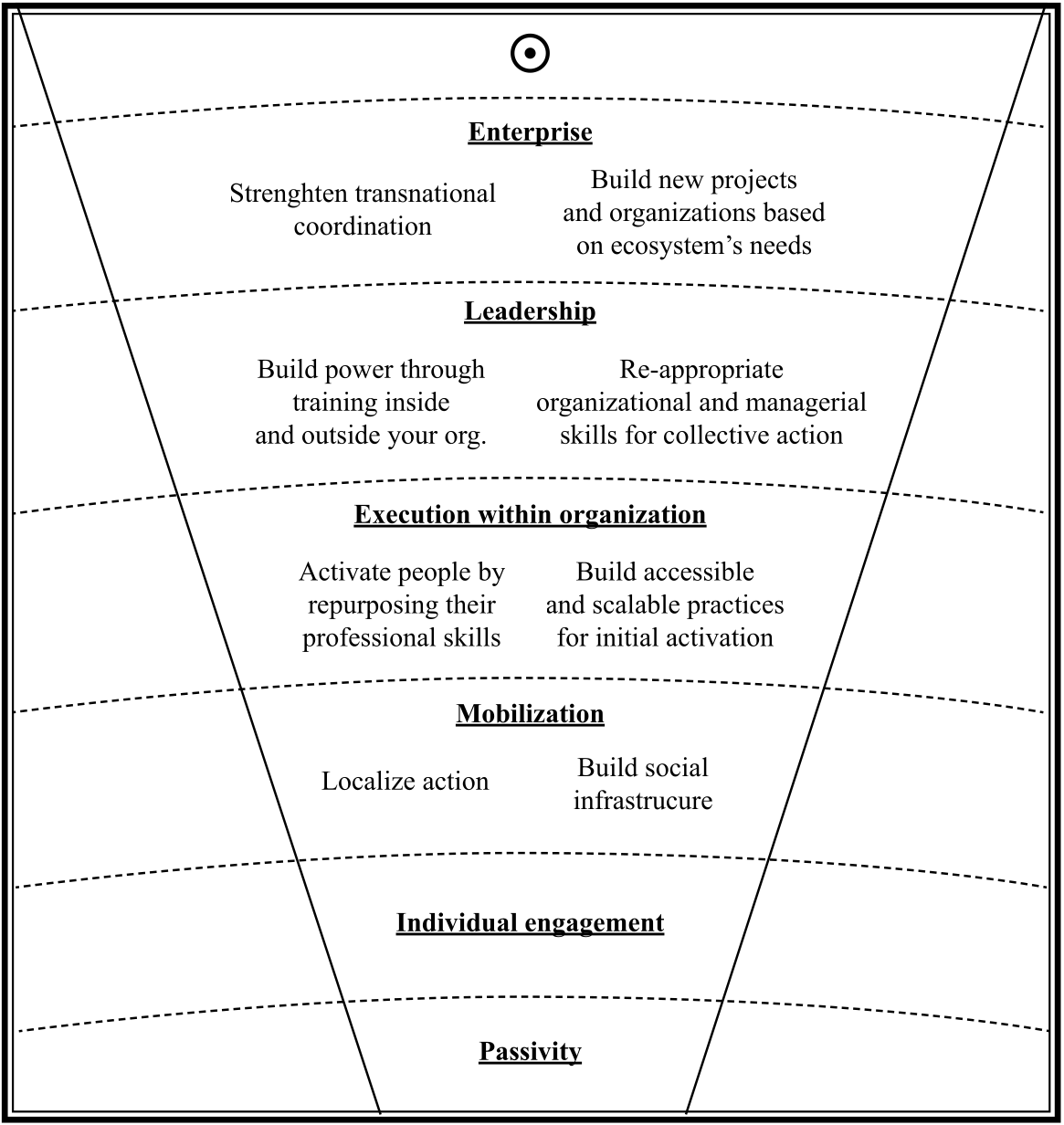
Fig. 3 Recommended interventions to strengthen capacity at different levels of activation
Functional Diversification
I won’t do a full functional analysis of the tech labor ecosystem for reasons of brevity, but let’s expand on some functions we touched on in the previous section.
I’ve identified a few underserved functions, starting from a perceived lack of specific forms of power, lack of resources, or visible outcomes, and proceeding backward. The result is an analysis of functions that new or existing organizations should fulfill to reinforce the ecosystem.
Narrative Function
The tech labor ecosystem lacks narrative and authoritative figures who can inspire us. We have been riding on the novelty of what we are doing for a while, and we have grown complacent. Journalists still treat unions being formed in a tech company as a quirky, new curiosity. It served us well for a while, but we need to shift gears.
It is time to develop our own media outlets and converge on a coordinated narrative around what DeCoTech looks like. The progressive intellectual class, especially in the Anglosphere, is failing spectacularly at this exercise, being unable to present a believable and compelling alternative to the world of misery offered by the American Tech Oligarchs. The bar is so low, and yet most of the discourse around solutions amounts either to vague gesturing at abstract concepts or to lukewarm policies trying to put a patch on the harm done by the techbros.
The new narrative function should also try to address the fragmented identity of the Tech Worker. Such identity struggles to develop because of the lack of shared material conditions across the workforce: an American full-time designer has little in common with an African data worker, an Indian food delivery rider, or a Taiwanese semiconductor floor operator. Suggesting what the right frame to bet on is beyond my pay grade, but it is clear it’s not sufficient to just point at the enemy to build commonality.
Even setting aside the ambitious construction of a global tech worker identity, narrative integration is still lacking within national boundaries: in many countries, tech labor organizing is presented as something happening primarily in big tech hubs and within product companies. This is sometimes an artifact of skewed media attention towards the newsworthiness of big brands, and sometimes it’s an actual asymmetry in the unionization efforts. The result is the neglect of a major portion of tech workers who are employed in smaller consultancies or work far from the major tech hubs. This narrative asymmetry also exists across national borders, with successful and mature tech unions like AGC in Argentina or SITT in Romania going mostly unnoticed outside of the usual spaces of international coordination like Uni ICTS.
To further complicate things, this split between tech hubs and IT backwaters overlaps with a composition in the workforce: generally, most migrant workers go for tech hubs, and they bring a whole series of different concerns and complications around organizing.
Such resolution of the Tech Worker identity might never come, and we should be ready to eventually move on to something more nuanced, able to coordinate across irreconcilable differences. The risk is to water down the construction of the identity to the lowest common denominator: a movement for everybody is a movement for nobody. The other risk is to define ourselves in opposition to Big Tech: while this frame is opening spaces to broader alliances, a negative identity never disempowers the object of its negation. We are tech workers because we build technology, and we will keep being tech workers after the last Big Tech CEO is uninstalled from the system. Positive, propositive narratives and identities in general can better capture the imagination of the yet-to-be-politicized, for whom anger and rage do very little.
On top of this, the Tech Workers Movement is still missing a rallying figure. We need our Greta Thunberg, a person able to mobilize the psycho-spiritual energy and galvanize a generation of organizers. A symbolic figure embodying our values without pushing for a single strategy.
No, the Pope is not an option. The renewed interest and appreciation that many tech workers and labor organizers have for the Church for its anti-big-tech stance is telling of the void that needs to be filled. Our Butlerian Jihad should be called by somebody who can customize their shell, not by a priest.
Mobilization Function
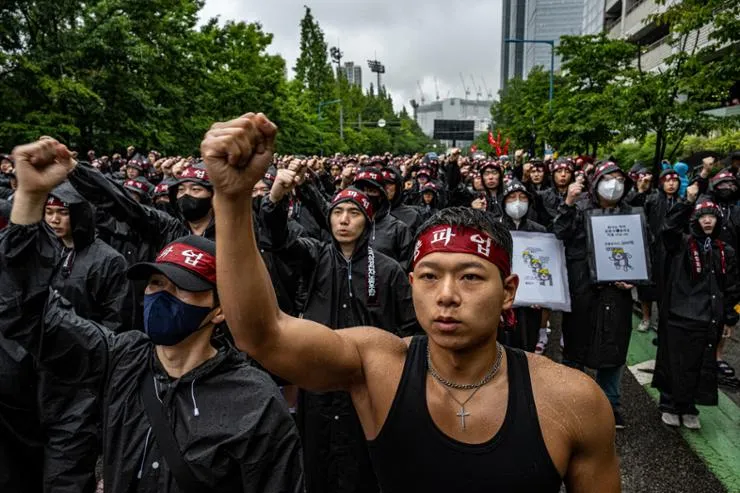
The Tech Labor Movement completely lacks mobilization power. Here, by mobilization, we mean a very specific systemic capability: bringing a large number of people not directly involved and contributing effort to an organization to do a specific action. Usually, this is a street protest, supporting an electoral candidate, or one-off money donations. Mobilization power, if wielded properly, can contribute to narrative shifts, institutional pressure, or be integrated into longer-term activation pipelines.
The Labor movement has historically prioritized associative power by involving workers in structured unions and building strong relationships among them through federations. Nonetheless, more recently, we have seen more experimentation around connecting labor conflicts with social movements. One example among many is the ex-GKN integration with the environmental movement and other local social movements in Tuscany. While the last word on the future of the GKN factory hasn’t been written yet, the impact on the overall movement in terms of acquired capabilities would probably be a net positive even if their demands won’t ultimately be met.
For Tech Labor specifically, I believe no organization currently active has the potential to fill this role in any national context I know, let alone at a global level. Such a structure should be designed intentionally, possibly following the Momentum model, the A22 model, or new iterations that aim to overcome the limits these models have shown in the past.
Beyond the workplace, STEM universities are ripe for mobilization: AI layoffs, political radicalization, and job precarity all fuel discontent that so far has materialized in isolated acts of protest or, at best, participation in the BDS movement to cancel universities’ contracts with the military or the Zionist apparatus. Engaging students with the narratives, demands, and goals of the labor movement has often failed, especially in STEM departments. The Tech Workers Movement must enter universities with an offer more compelling to students than the individualist Effective Altruism ideology or the doomerist nihilism pushed via social media.
Financing function
The Tech Labor Movement developed over the years some financing capabilities through traditional structures: union fees, cooperative funds, occasionally some public money.
These resources tend to stay local to their environment and rarely support experimentation, grassroots organization, or research that goes beyond the immediate needs and frame of the funding organizations (i.e., union research centers).
A lot of the Tech Labor Movement, such as NGOs, litigators, grassroots initiatives, or large events, depends on lines of funding coming from liberal organizations without much political alignment. This forces organizations to do acrobatics to fit pro-worker initiatives in grant applications meant for something else, wasting time and limiting potential impact. This is obviously a problem common to whoever wants to extract funding from the Non-Profit Industrial Complex and not specific to tech.
Tech Politics, though, has a few differences that are worth unpacking to imagine additional forms of funding.
The first is that a solid portion of Tech Workers still have very high salaries. In the USA, these are the same people who showed interest in workplace organizing against any materialist analysis, and they jeopardized their careers to form unions in their companies. For every worker who takes action, there are many more who would like to, but cannot rationalize taking the risk. In my experience, they are more than happy to contribute monetarily to radical pro-worker initiatives. Out of guilt, political conviction, or need for belonging, they are happy to part with some of their salary if it helps the Tech Workers Movement. Isolated crowdfunding campaigns should be systematized into a regular stream, collecting contributions from people that unions cannot reach.
The second specificity is the ideological permeability of ample portions of the tech elites. For every Elon Musk or Peter Thiel, there are hundreds of multi-millionaires who made money by being incidentally in the right company with the right stock options, or maybe because they started and sold a start-up at the right time. These people tend to float around the ideological spectrum to fuel their need for agency in the world. Techno-optimist, if not technocratic, ideologies capture their attention, and their money. Effective Altruism is one such example, but also more traditional liberal values repackaged for them by NGOs and foundations work well enough. These people, identifying themselves as builders rather than managers or financiers, offer the flank to forms of class traitorship that are currently underexplored by the Tech Workers Movement.
If this traitorship-based funding is seeing traction on topics like environment and anti-fascism, with traditional philanthropic models being questioned by more radical entities like Guerrilla Foundation, very little, to my knowledge, is being done yet to organize the tech elites in alignment with workers’ interests.
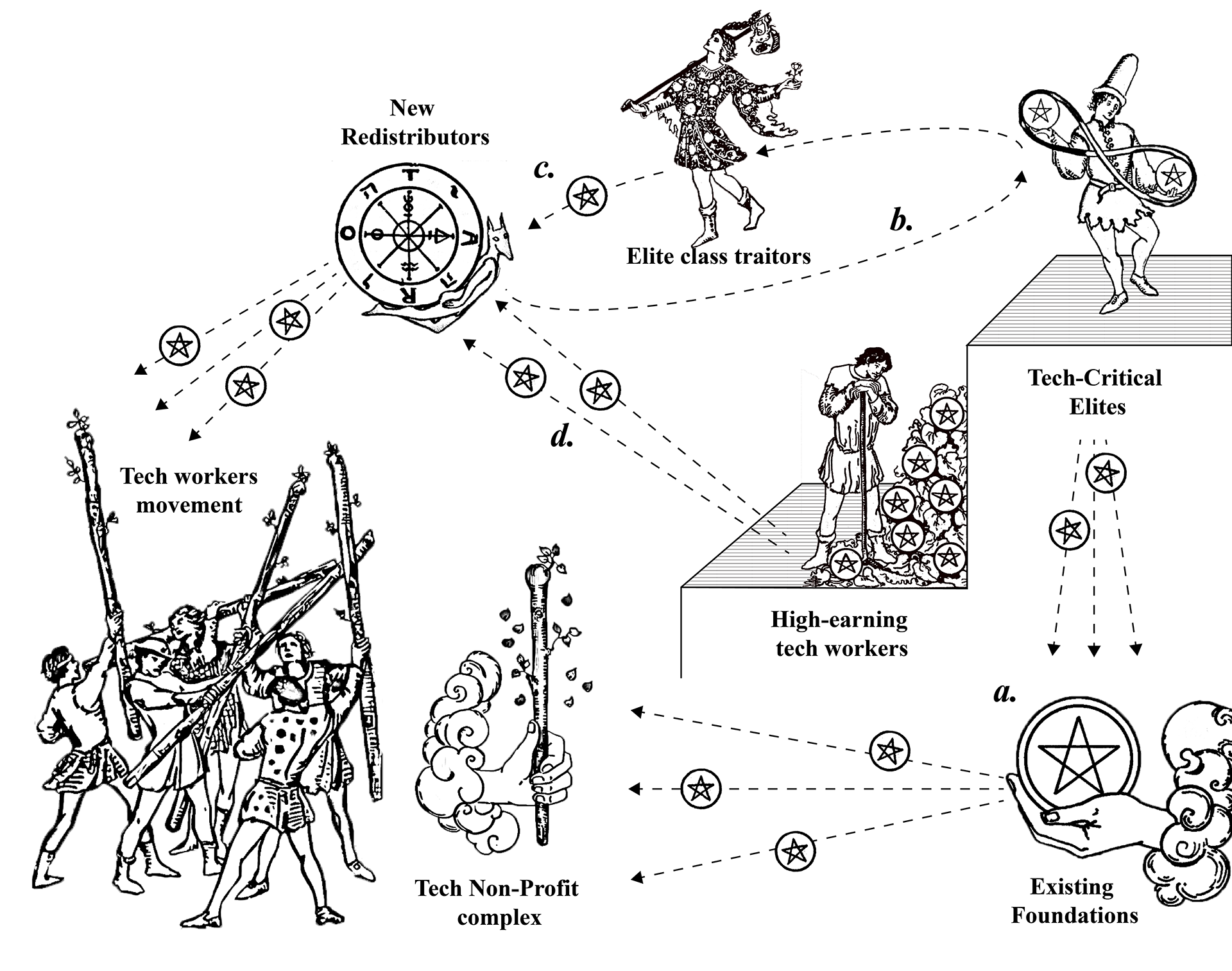
Fig. 4 Reallocating Tech Elite resources — Old and New Functions
a. Existing foundations redistribute money from tech-critical elites to the Tech Non-Profit complex
b. New Redistributors must turn tech-critical elites into elite class traitors
c. New Redistributors will funnel money from elite class traitors to tech workers movement
d. New Redistributors will funnel money from high-earning tech workers to the tech workers movement
Strategic Diversification
Starting from the principle that successful strategies are discovered through their enactment and not designed independently from the ecosystem that should put them into practice, I isolate a few under-explored strategies that the Tech Workers Movement is currently underestimating. The idea is to expand the surface of attempted strategies at the ecosystemic level, and therefore increase our chances of developing highly effective leverage.
Bottleneck targeting
Digital Infrastructure, like any other infrastructure, has bottlenecks and vulnerabilities. Through computers, networks, cables, and screens, information flows from one brain to another, from one machine to another. This information represents money, social relationships, commands, knowledge, emotions, and so much more. Today, interrupting this flow means interrupting material production and society itself.
Like dock workers have a special technical role in the logistic infrastructure from which they derive a disproportionate amount of leverage, so do some categories of tech workers. System Administrators of digital infrastructure, for example. This category is punished for any minimal form of misalignment with the interests of the company or the State, exactly because of the fleshy vulnerability they represent for social order. We are, at any given point in time, 500 disgruntled SysAdmins away from civilizational collapse.
How to build a social and organizational infrastructure that allows for the effective coordination of acts of resistance by these key workers is far from trivial: the consequences of exploiting the full leverage given by their position would likely equate to a form of martyrdom. Developing a path to a “safe” exit is even more challenging, especially without relying on the interests of authoritarian governments, as was the case for many tech whistleblowers. This activity is also time-sensitive: every digital infrastructural component, once mature enough, starts seeing investments to raise security, increased lockdown of specific functionalities, and reduced vulnerability from rogue contributors. This raises the costs of this hypothetical form of organizing, in terms of key individuals to bring on board to create impact.
The same vulnerability represented by SysAdmins can be observed in specific companies: an extreme concentration of power and emergent monopolies also inevitably create structural vulnerabilities over more decentralized configurations. TSMC, ASML, but also other more specialized hardware suppliers, are such examples.
The Tech Labor Movement should identify small and big bottlenecks, understand their leverage, and organize the workers on which they depend. This would allow for the accumulation of leverage to spend on more ambitious political demands that are now out of reach. This shouldn’t just be a tactic contextual to a specific goal where bottlenecks are present, but a rational strategic incremental shift away from the path of least resistance and towards high-reward targets. Such effort should be aligned alongside other disruptive actors that are emerging, such as the movements resisting the construction of data centers.
Movement Integration
The maturation of the Tech Workers Movement coincided with a stark change in its perception by its political peers. A few years ago, most people were deeply skeptical that tech workers could even begin organizing. Today, every time I engage with political spaces operating at a high level of strategic reflection, the existing, or imagined, potential of tech workers taking sides with a given political cause attracts disproportionate interest and excitement. Those who were once perceived as passively subservient to their employers are seen today as potential allies already positioned at a critical point of leverage that can’t be reached by outsiders.
We must take note of this interest and act accordingly. On one side, this will come in the form of distraction, fragmentation, and dispersion of resources. On the other hand, it will open up many and diverse forms of political engagement, able to mobilize tech workers around new issues, i.e., environmentalist causes, anti-militarism, housing rights, etc., and activate tech workers as political tech workers, rather than simple citizens. This is a qualitative change since many of us so far have been leaving home the tech worker hat when engaging with political spaces outside of tech labor.
Beyond power building within tech companies, the tech labor movement is seen as a potential provider of effective movement infrastructure and technological practices. Where the FOSS movement is trying but struggling to emancipate itself from a focus on the rights of software and individualist politics, tech labor organizations are seen as capable of providing technical know-how embedded in a logic of collective action, societal engagement, and materialistic theories of change. The main obstacle at the moment is the lack of connections between motivated volunteers and political organizations that, in theory, could benefit from tech-savvy volunteers. The movement should both cultivate means to scale up this form of matchmaking (i.e., dedicated platforms) and to educate both tech volunteers and organizations to the possibilities that a surplus of tech labor in the movement could offer (i.e., critical digital literacy and autonomous infrastructure).
Data centers’ resistance and the unfolding of the AI project by tech oligarchs in particular, being hostile to labor as much as to society, is the perfect stage to practice this integration. Unions, social movements, and still-functioning components of liberal democracies have a common enemy, attracting a lot of popular resistance across the political spectrum. A new Politic, with the capital P, is happening around AI in a way that hasn’t happened much in recent times. The Tech Workers Movement, for obvious reasons, is perfectly positioned to seize the opportunity and link the immediate fears capturing people’s attention to the broader political, social, and spiritual implications of the AI project.
Institutional overhaul
The Two Loops theory of change prescribes that for every function abandoned by the old system, the new system must be ready to fulfill the same function in a new way. This is both to ease the dismantling itself and to avoid a vacuum that might give space to undesirable patterns.
The dismantling of the power of techno-capital must be matched by the growth of democratic control of technology at the level of conceptualization, production, validation, governance, and dismantling.
To do so, cooperatives, open-source, and grassroots software development are not enough. The overhaul must happen at every level of the technological stack, from hardware and infrastructure to software, up to the mind of the user to turn them into an active participant in their own technological autonomy. Such deep restructuring cannot happen at the local level on a small scale, but must be coordinated by bigger institutions, which don’t exist yet.
Nation-States and their components are failing every adaptability test posed to them in the last few decades, possibly with the exception of China. State Institutions are proving unable to protect themselves from the onslaught of big tech influence, in the form of predatory contracts, lobbying, narrative-setting, escalating more recently into a deep embedding in the military, energy, and logistical infrastructure. Institutions that cannot protect themselves and their autonomy from hostile takeovers have no chance to serve society or the working class.
The recent retreat to municipalism still leaves a degree of agency within existing institutions to contain the harm of big tech at a local level, but it’s not a systemic solution yet.
The Tech Workers Movement must spearhead the construction of Counter-Institutions, within or outside the State, depending on your theory of change and ideology.
The ultimate change must be to render it fundamentally unviable to monetize technological production without oversight by democratic institutions. If it were once possible to buy untested medicinal drugs, after the industrialization of medicinal production and several catastrophic incidents, we agreed as a society that the commercialization of certain substances had to be subject to restrictions and extensive validation of the effects and risks involved. While the process definitely improved the reliability of drugs, it was still spoiled by the fact that it was designed to favor the concentration of power in a few big actors now known as Big Pharma.
If we get to establish a similar transformation in the way software is produced and introduced to society, we must go to the root of the problem and flip the power relationship between organizations producing software and the society adopting it, to avoid repeating the mistakes of the past. Implementation of software with impact at large scale should be a process requiring consent and participation from the communities impacted by it. Tech production should stop asking for forgiveness and be forced to ask for permission.
After Silicon Valley
The USA tech industry has constituted, for a long time, at least on the narrative level, the main battlefield of the Tech Workers Movement. There, most of the tech companies influencing our lives were being questioned, and workers were rising against their CEOs. While the vast majority of the unionized tech workers were far away from the Bay Area and New York, their local power was considered secondary in the grand scheme of things.
Times are changing, and Uncle Sam’s dominance over allied infrastructure is losing its grip. China is playing its game to fill the void left at the margin of the Empire. Europe is pushing for nationalistic replacements, hoping for a long-overdue detachment from digital tentacles reaching from across the ocean.
At the same time, rising authoritarianism in the Imperial core and the strong class solidarity of the Techno-Capitalists are leading towards harder times for American organizers. With further integration of Big Tech companies in the military-industrial complex, unions become not only a political enemy of the government, but a threat to national security. Looking at these struggles for inspiration and direction would be a risky move.
New ideas and prospects for the adulthood of the Tech Workers Movement must come from elsewhere, from the periphery: movements in Brazil, Central Africa, the Mediterranean, India, or Indonesia are all developing their own path through techno-politics. If done without exoticizing and also without a spirit of escapism, it is useful to look at what tech workers and communities are doing at the margins.
The fate of Empires is not decided in palaces, but in a tent in the middle of the steppe.
Any successful asymmetric conflict shifts the battlefield to leverage what is abundant for the previously weaker party and scarce for the dominant party. If you’re a Xiongnu, this is fodder for horses, hence mobility. If you’re an Italian partisan, it is hiding spots in the mountains and popular support.
What is it that we have that tech oligarchs struggle to manufacture? My answer is: meaning. Despite billions put into maintaining the circus that props up the Californian Ideology, in 2026 the tech industry is going through a crisis of meaning. Workers don’t know why they do what they do, and if they do, they likely hate it. Most jobs are bullshit, and the others are harmful. On the other side, the promises of collective action, of applying your skills towards social change, of having a positive impact on the world and just being a good person, are something that a re-engagement with politics, in its new forms, can offer.
This article contains a lot of strategic advice, but I invite you to incorporate everything by keeping in mind that the people we want to activate in the millions do not yet think, feel, and live as we do. They do not know that what we are doing here can fill your life, can bring you friendships, and ultimately make you belong to something bigger than yourself, defeating the loneliness that scars the existence of most people. Meaning, belonging, and comradeship are needs we are better positioned to fulfill, and we should not be afraid to do it.

I want to conclude with a last reflection. The Techno-Capital complex has shown in the last few decades not only an impressive ability to expand its capacity and its pervasiveness in societal structures, but also a rapid rate of change. We have seen throughout the article ways to get a shot at developing structures that match Techno-capital in power, and we have constrained our strategies to allow us enough flexibility to keep up with the unprecedented pace of change we have to operate in.
While a systemic, pluralistic approach based on political ecology creates the conditions for adaptive political structures to emerge, the whole endeavor is pointless if these containers aren’t filled by personal initiative. The variety of organizational tactics, approaches, and structures must match in variety the ever-changing configurations of techno-capital, and this cannot happen through the now-outdated norms of political action based on a cycle of analysis-synthesis-action-assessment, simply because they are too slow compared to the phenomena they want to address.
We need to recuperate the concept of Entrepreneurship from the capitalists, make it ours and make it collective and cooperative, rather than competitive. The word Entrepreneur predates capitalism, and it indicated an undertaking not necessarily connected to the economic sphere, let alone an exploitative one. Entrepreneur was much closer in vibe to Adventurer than to “dude with a rich dad trying to buy its first yacht.” While the whole frame risks retaining individualistic or even colonial undertones in some parts of the world, it can still be articulated to capture and foster energetic initiative to be put in service of societal good. The willingness to take risks trying new things must become the new norm to really see a rich and healthy political ecology. We need to reward experimentalism rather than punish the failure of those with strategies different than ours.
A young person willing to build something meaningful and leave a mark on the world shouldn’t have as their main outlet the start-up pipeline or a big-tech career, but rather look at political engagement, or even just social businesses and cooperatives, as the most socially and psychologically rewarding option.
It is clear even to the most distracted observer that we are living through the End of the End of History. The recent decades have placed us, the Tech Workers, in one of the most critical positions to determine what will come next, in the same way that, in the second half of the 19th century, the struggle of the new workers, the factory workers, determined the destiny of the whole World.
Strategizing in interesting times is always hard: today some of us can still rely on democratic guarantees, the freedom to conduct our lives as civilians, or the existence of consumer computation available to most of the population. These assumptions might not last long, and our strategy has to change as quickly. Maybe this article will age well, or maybe it was already obsolete at the time of writing.
Regardless, Clio wields her stylus once again: glory is up for grabs and suffering is on the horizon. Too many today already celebrate the collapse of the Empire: the real horrors are yet to come. Not all of us will go through the next years in the same way: care for the vulnerable, commemorate the martyr, but sing with pride the deeds of your comrades.
Nemesis Adrasteia, late yet inexorable, leads us in our fight for retribution. Techno-Capital, as the latest avatar of capitalistic disordering of the World, is not only a threat to the dignity of workers but a menace to Life itself. Scenarios of the Techno-Capital emancipating itself from the realm of the Human, once unlikely speculation for philosophers, look today more like a concrete goal of the Ketaminic Californians. As such, dismantling the Techno-Capital as soon as possible is not only a political battle, but an existential necessity.
Winning justice is not enough. We will be done only once another offense against everything that is Good would be not only infeasible but inconceivable.

Faith through fight!
Vinceremo!
Reading recommendations:
– Neither Vertical Nor Horizontal, by Rodrigo Nunes, Verso Books
– All In – A Revolutionary Theory to stop Climate Collapse, by Marian Rodrigues, Sinan Eden
Get Involved:
– Tech Workers Coalition: techworkerscoalition.org
– No Tech For Apartheid: notechforapartheid.com / notechforapartheid.eu
– Game Workers Coalition: gameworkerscoalition.org
Learn:
– Architectures of Change: architecturesofchange.xyz
– Ulex: ulexproject.org
– Movement Ecology School: movementecology.org.uk
– Momentum: momentumcommunity.org
– Organizing 4 Power: organizing4power.org
Download PDF
– PDF version for digital visualization
About the authors
Simone Robutti has been an organizer in tech for many years. He helped start the Berlin chapter of Tech Workers Coalition, and later the Italia and the Global chapter, in which he currently leads strategy activities and the support structures for chapters around the world. He co-organizes Cables of Resistance, a major anti-big-tech conference in Germany. He coordinates Reversing.works, an investigation group using network traffic analysis to find violations of workers’ rights and privacy on mobile apps. He teaches political organizing at Architectures of Change. He writes about agency and political mysticism with the Reincantamento collective.
Daniela Vaccaro is a multi-faceted designer working with organizations through participatory and strategic design processes, integrating visual design and editorial work as part of this practice. Her focus sits between governance strategies for organizations and networks and the activation of cultural spaces. She wrote about the relationship between public space, collective action and rituals. Among her publications is Zone of Offensive Opacity, published by Becoming Press, exploring carnival, anonymity, and opacity as forms of resistance to algorithmic surveillance. By collaborating with Reversing.works as a designer, she began working with the topic of tech labor organizing.