§0. There was a European Movement Strategy Conference in September 2026. In it, there was a session on Mass movements through daily grievances, which we facilitated. Here are some brief notes from that session.
Political Context
§1. The good old US hegemony used to rely on the soft power of UN institutions and European diplomacy, as well as the hard power of NATO and CIA. This hegemony is now challenged by the emergence of China, which builds its soft power via, for instance, BRICS and Belt Road Initiative. (One could argue that Russian military is its hard power, to some extent.)
This produces a crisis of hegemony, without yet an overt dispute over hegemony.
With Trump, the US seems to play for imposition rather than influence.
China became a net value importer. It’s building its own infrastructures. However, its power still depends entirely on the US dollar and therefore cannot challenge the well-being of US economy.
§2. Some ten years ago, European economy was converging with Chinese economy. (The overland route of Belt Road Initiative starts in China and ends in Europe, going through Russia or Iran.) Reaching its peak in the 2014 far-right mobilizations in Ukraine, the USA’s provocations eventually resulted in Russia’s invasion of Ukraine, which cut off the convergence between Europe and China.
This resulted in the submission of European economy and politics into the US economy. We see it in the political disorientation and the geopolitical irrelevance of European state actors. We feel it in its immediate results such as
- increased military spendings accompanied by public cuts (investment in arms, sending of arms to Ukraine, compulsory military service, joint European army discussions, etc.)
- Trump’s bullying (Greenland, NATO budget, etc.)
- increased cost-of-living (energy crisis, increased food prices).
Combined with the climate crisis (heat waves in western Europe, forest fires in southern Europe, heavy rain and floods in (parts of) northern Europe), this produces a hegemony crisis within Europe.
§3. This hegemony crisis in Europe has different facets.
- The establishment parties are struggling to maintain their legitimacy.
- The far-right offers itself as the alternative agent to manage the climate collapse on behalf of the capitalists.
- The far-right is aware of the upcoming climate collapse. It is divided and has a dispute for leadership at the European level. (ECR with Meloni; Patriots with Le Pen and Vox; ESN with AfD)
- The left has been shy to offer an exit strategy. Antifa strategies became instrumental to maintain the status quo in power for longer.
§4. What to expect from the status quo in the upcoming years:
- More migrants, less rights: All center-right and far-right politics relies on having more migrant workforce in Europe. And they are explicit about this. What they are against is that these workers have political, social or economic rights.
- Climate disasters, particularly with the Super El Nino period and the weakening of the Gulf Stream.
- More disciplined labour: This is a wide range of policies including labor reform, pension reform, anti abortion legislation, austerity measures, and criminalization of social movements. In addition, suppressing migrant rights will help discipline the rest of the workforce.
- Militarization, not only in investments and expenditure in the military-industrial complex and cuts in public services, but also compulsory military service, insistence on creating a European army, etc.
- Authoritarian regimes to execute the above; in many cases, without implying a change of government.
Seizing the Opportunity
§5. In short, what awaits us is increased popular dissent, combined with a hegemony crisis. “The old world is dying, and the new world struggles to be born: now is the time of monsters”, Gramsci said by the end of the Second World War. The hegemony crisis of the time enabled anti-colonial revolutions to have major victories.
If we take proper advantage of the political context, many possibilities will open in front of us.
This will require building a mass movement.
If we don’t do this, the far-right will do it instead, turning an opportunity into a threat.
§6. Building a mass movement is not a new idea. We rely on centuries of experience from around the world. In a nutshell, it rests on three main pillars: mass involvement, mass mobilization, and radicalization.
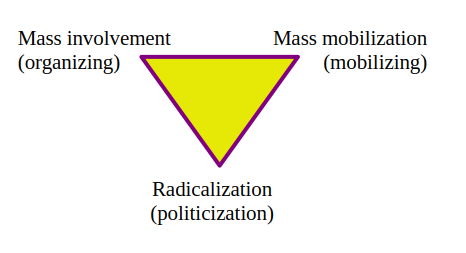
Mass involvement, sometimes called organizing in Anglosaxon literature, would be bringing different sectors together in unity and struggle.
Mass mobilization, sometimes called mobilizing in Anglosaxon literature, would make people move and do things for the movement. This can be as simple as showing up or talking to your neigbors.
Radicalization or politicization, absent in most Anglosaxon literature on social movements, is the political training people get through engaging in the movement. It is the formative process of identifying the root causes of the problems we are facing.
Naturally, these three pillars are interconnected within the movements, impacting each other.
§7. The pillar that is lacking most crucially in European movements is mass involvement / organizing.
§8. When we lack mass organization, our movement becomes much weaker.
We have less capacity:
- Without the masses, our narrative capability is reduced as it is harder to argue that we stand for the interests of the entire population.
- From a more strategizing viewpoint, lacking perspectives of different sectors of the society also makes our strategies much less realistic and much less robust.
- We enter into logistical difficulties, which limits our autonomous options.
- It is harder to build trust within the movement, which then conditions who we can count on and what we think is feasible.
- We fail to maintain a consistent message circulating in the wider society.
- We have difficulty in create new leadership in the movement. This in turn creates a de facto hierarchy, where masses go back home after a mobilization, waiting to respond to the next call.
- Lack of ownership of the movement means that many people gradually get tired and leave.
- A long-term political training becomes impossible in this context. This also means that it will be harder for us to respond to ideological deviance in the next mobilizations.
These have the further implications on our ambitions:
- Our movements become more reactive and cannot take initiative in agenda-setting.
- Since there is no popular power built within the movement, our strategies rely on the State’s response to trigger societal change. This further implies that all movements end up being movements of “building pressure”, which results in a distorted political analysis and an inadequate theory of change.
- Overall, a movement that feels alive is also a movement with strong capability of imagination.
These are also associated to repeating the same mistakes, rather than learning from past experiences and making brand new mistakes.
Finally, this entire process is accompanied by an organizational culture that tends to be more and more inward-looking, instead of engaging with diversity, conflict and contradictions. So, in a way, it feeds back to itself.
§9. On the other hand, there are loads of daily grievances and material needs our movements can focus on.
The up-side of working on a little explored terrain of action is that there is so much work to do and so many options to choose from. As the participants of this session, we identified several possibilities in our contexts, including
- basic needs (food, poverty, housing)
- public services (transport, health care, education)
- care work (childcare, elderly care, mental health)
- sense of belonging (community, kinship, connection)
- labor conditions
- climate impacts (chronic droughts, extreme weather events)
- political and social inequalities and injustices (racial violence, deportations, migrant rights, gender-based violence)
§10. We can work on any combination of the above-mentioned areas. But it is also important that we acknowledge that we might not be ready yet for the base work / organizing, which requires a different attitude and a different skillset.
It’s okay not to have everything figured out from the beginning. What matters is that we are able to recognize our own weaknesses, limitations, and mistakes, and start moving towards overcoming them. Organizing is not a skill that can be mastered only through theory: we learn by doing. It is through the actual practice of organizing—trying, making mistakes, reflecting, adapting, and trying again—that we develop the attitudes and skills needed for effective base work. In this sense, our weaknesses are not necessarily a reason to wait before we begin; the organizing work itself is what allows us to work on them and grow.
There is no exact recipe for mass organizing: methods depend on the objective, the context, and the people involved, and what works in one situation might not work in another. This means that we need to remain flexible, learn from experience, and develop our approach according to our own context.
§11. At the same time, there are some common mistakes that movements tend to make.
These include confusing the instrument with the objective, turning particular ideas or methods into rigid dogmas, or assuming that one organizational model can be applied everywhere.
We can also weaken a movement by treating democracy as something that concerns only those who lead, by trying to direct a movement in a straight line without responding to changing conditions, or by attempting to lead without sufficient preparation.
Finally, we need to avoid confusing discipline with obedience, disregarding the values and culture of the people we are organizing with, or failing to combine clear direction with genuine mass participation and action.
Recognizing these pitfalls does not give us a recipe, but it can help us approach organizing more consciously and adapt our practice to the realities we face.