In All In, we search for a theory of change and an organizational model that can deliver the task of dismantling capitalism in the short term. To describe the solution we encountered, we use the expression “movement-as-party”. Let us start by quoting a few parts first.
“By party we mean an organization with rules and procedures on internal functioning, that has a visionary proposal for society.”
…
“A movement ecology approach can indeed unleash enormous potential in this direction. A global articulation of diverse lived experiences of capitalism is possible once we lift the movement into the party category in the organizational sense. Equivalently, we are arguing that in a globally integrated capitalist system, the historical functions of the party will be fulfilled at the movement level and perhaps only at that level.”
…
“But for this to work, the movement would have to agree on why it exists and what it’s supposed to achieve.”
After this, we go ahead and use some movement typologies to make this approach more tangible and operational. This praxis-orientation has also been the driving force in the workshops and in the movement-level interventions.
In this short note, we’ll take a step back and clarify what the endgame is for the journey we embarked on with All In.
Movement-Level Strategy
The section on movement level strategizing (§5.2.2, if you have the book at hand), although quite straightforward, requires some time to pause and reflect. There, we talk about movement level interventions. So let’s pause and reflect on why we focus on interventions that improve the effectiveness of the movement as a whole.
The underlying idea of movement level strategy is that we will need a complex movement ecosystem. (There is a part we’ll skip now (namely, the ruptural model of transformation debate) and focus on other aspects (grand strategies and movement capabilities).)
In order not to repeat the entire book, let’s proceed over an example.
Complex Movement Ecosystem: Grand Strategies as diversity
We need a cluster of movement actors focused on agitating against militarization, armament and wars. This would include campaigns, alliances and organizations of different kinds. Some would organize the youth, others would focus on cost of living, etc. This cluster would need to be tightly knit, because they would need constant communication and detailed coordination.
We need another cluster of movement actors focused on seizing the outrageous moments when millions come to the streets unexpectedly. This would include other organizations and networks who specialize in vanguard and rearguard functions in a mass mobilization. Some might do community organizing to build trust, while others might offer civil disobedience trainings or set up legal support structures etc. This cluster would also have to be tightly knit, because they would benefit from sharing experience as well as do joint political analysis about current events.
It is helpful to see these clusters as separate, not only because they focus on different opportunities but also because in real life they will operate separately. They would probably think that the other cluster has a completely unrealistic expectation of what will work. This separation allows the elements of both clusters to stay focused on their plan and consolidate their convictions. Nevertheless, they would have to get on with this separation – acknowledging that the other might be right after all.
Now, these clusters would have to be bridged. This, for two reasons.
First, they would need to trust each other. When reality seems to prove any one of them right, then the others should be able to come on board immediately: if there is an outrageous moment and the second cluster is activated, then the first cluster should join in to support them.
Second, because of movement capabilities.
Complex Movement Ecosystem: Capabilities of the movement
Movement capabilities are defined at the movement level, so they serve across the board. Different organizations contribute to different capabilities in their own specific forms, and coordinating these contributions across the whole movement makes the entire movement more effective.
The bridges between the clusters are probably not as tight as within the clusters. Examples of it are loose networks among communication teams, among spokespeople, among digital security officers, etc. In some cases, specific capabilities might have stable networks of their own. This is the case of a lawyers’ association providing support for a wide range of organizations, for instance.
The coordination capability would be seen in various ways. It can be inside each cluster or crosse cross clusters, carrying a specific capability over to another movement actor. It maintains the relations between the different elements (especially between different clusters), the flow of information, and trust building. This can be done through informal relations, formal networks, specific organizations, in the halls of the joint conferences, etc.
The Novelty
The resulting movement ecology is hard to picture because of its intertwined nature.
It matters a lot for us to underline the word “complex” we are using. We are not using this as a buzzword. We use it under its formal definition of “the behaviour of a system whose components interact in multiple ways so possible interactions are difficult to describe”.
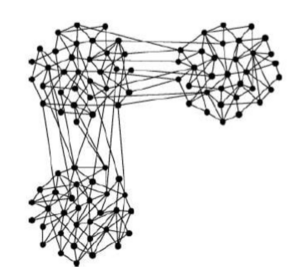
Let’s recap.
We would need to imagine clusters based on scenario planning, which in turn form clusters of grand strategies. These clusters would have several bridges. Besides, we would need to have capabilities identified per cluster, and check for articulations among them.
The image we use in All In barely scratches the surface.
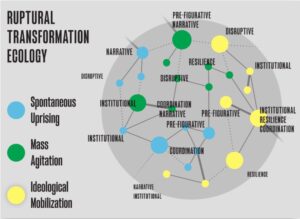
So far, this article seems like a recap of the main propositions of All In. But we have a specific agenda in doing this.
When we launched All In a year ago, we insisted that it was not a book nor an argument. It was an attempt at answering a question of theory of change, and the answer, by definition, can only be made through praxis. The last sentences of All In read “We are recruiting you to an honest and empowering venture.” So that’s what we have been doing with comrades that we knew from before and with comrades that we met along the way.
The problem arises when we agree on the task but don’t have a common understanding of the novelty and clarity that movement-as-party brings. This happens because movements and parties existed for a very long time and we all have had experiences with them. Movement-as-party, heard as an expression, recalls these past experiences and we all have a natural tendency to repeat previous frameworks.
We want to be extremely clear and straightforward.
We are not creating the brand new “vanguard party”. We are not aiming for “uniting the left”. We are not trying to “coordinate the movement”. We are not the Eleventh International.
All of the above are desperately needed. Some are more essential and urgent than others. None is The Solution.
Our movement-as-party approach implies that we focus on movement-level interventions and movement-level contributions. In this framework, there would be several “vanguard elements” (holding different leadership kinds) and various kinds of “unities” (strategic, tactical, institutional/formal, ideological, etc.). In this framework, it is meaningless to talk about “coordinating the movement”; instead, we would try to “increase the coordination capability of the movement”.
Moving Forward
This clarification matters, particularly as our work starts to give fruits.
We hope to inspire, incubate, and/or implement movement-level interventions, as you might have noticed in the All In – Applied section of the website.
We have two general success criteria for an intervention: first, that the entire movement configuration reaches a better state by the end of it; and second, that it provides a pathway compatible with the task (system change + climate deadlines).
What happens to the All In project itself is not a topic of significant consideration to us. As a matter of fact, one could say that All In itself is a movement-level intervention and we aimed it to be obsolete as fast as possible.
Our point is that we are not trying to build a party-as-movement. We are here to build the movement-as-party.
Don’t take us wrong. There are quite some arguments in All In, about what we understand from class struggle, about globalization, about what our historical task is, about an ecological approach to movement building, about models of transformation, and some more. We are not shying away from these arguments: we want to win them all in the movement.
However, aiming for creating an organization or establishing a movement that would “represent” all these arguments would go against the entire framework of All In. It would also mean ignoring complexity. We are really keen not to do this. We sincerely think that we have a framework that can hold the complexity.
When we say
“The task is magnificent, horrifying, and emboldening. We are not supposed to “overcome” our fears. We are supposed to find courage inside our fear, anguish and anxiety. At the end of the day, we are making sense of a world that doesn’t make sense and finding the hope to face reality with empathy and boldness.”
we are not tear-jerking. We seriously mean it. We honestly think there is a way of getting out of this mess. We honestly think a movement-as-party approach could pull it off.
“Why, sometimes I’ve believed as many as six impossible things before breakfast.” says the White Queen to Alice in Through The Looking Glass. This more or less summarizes our approach, too.