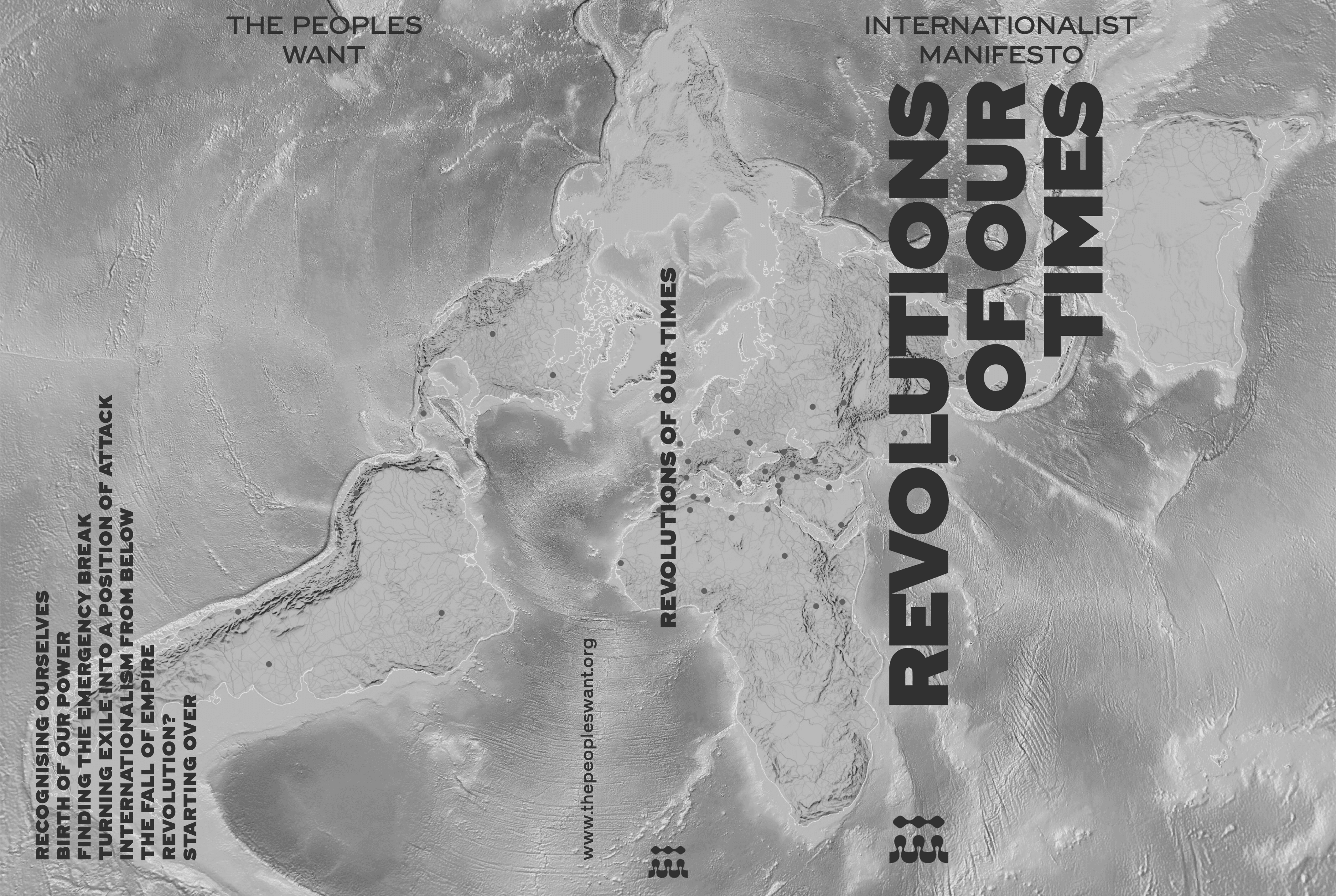
I had been traveling around central Europe for over a month, visiting cities, organizing workshops, and meeting new faces and comrades, when I first laid my hands on the Peoples Want manifesto. After a long conversation accompanied by the incredible food from the Syrian Canteen, I realized I was in the right place. Over the next few days, I read and reread the manifesto – a bit slower since the only printed version available was in Spanish – as I carried on with my travels, feeling inspired and excited by the manifesto written by people from different parts of the world (Lebanon, France, Syria, Tunisia, Chile, Kurdistan and Iran) many exiled nowadays in Europe.
Although one could find it a bit long to be called a manifesto, it is definitely an excellent offering of the analysis, concerns and boundaries established after what it seems to be long and deep conversations between a diversity of revolutionary experiences, trials and mistakes. Inbetween my conversations with groups in Europe whose inaction, lack of ambition, and depression are often frustrating and even contagious, this manifesto gave me a breath of fresh air about the existence of organized people who are currently trying, focused, and still ambitious to win. That alone would be reason enough to recommend this read.
If you read All In and are aligned with it, then I find hard that you will not be aligned with this manifesto. With a different approach and aim, it has similar anchors and visions of where are we, where we need to go and how to get out of this mess. I would dare to say that if you read the manifesto and are aligned with it, them All In is a needed reading for you and we should talk.
Let us highlight three main points we strongly agree with:
– We need to have international plans that are compatible with our resources, that are strategic and have the ambition to win in our lifetimes. Some of the sentences that spoke to us most are: “There’s a need to build a common plan between these worlds. A plan that will enable us to circumvent Empire, hasten its fall and imagine the aftermath.”; “We need to focus, measure our actions and strike where striking can make a difference.”; ” it’s only by confronting it everywhere, simultaneously, that we may one day share in its downfall”; “we can meticulously organise an exit plan, betting we can extract a plausible future from an improbable present.”; “there are times when not to take risks is a risk not worth taking.”
– We need a strong ruptural movement (currently almost non-existent in Europe). Change will not happen from within institutions or through spaces that ignore the state and create alternatives “outside” the system. Despite the contributions that these forms of struggle can bring, what is needed today is a ruptural approach, one that confronts the state and builds power from the people and for the people. Some of the sentences with which we related the most: “We are placing our bets on those who want to change the rules of the game, rather than on those who want to win the game as it is.”; “It’s only by coming together collectively and taking control of our basic needs for safety, health, access to housing and food that we will be able to claim our independence from Empire beyond the moment of insurrection.”; “The revolution we seek is neither the refusal of power, nor its negation. That would mean perpetually leaving power in the hands of our adversaries.”
– The importance of learning from the past, carrying learnings forward within the movement and learning from each other in real time with kindness, honesty and accountability. Some of the sentences that we felt a strong connection with are: “the answer is never absolute or eternal; it can only be momentary, provisional, situational.”; “we need a revolutionary tenderness capable of listening; wanting to understand; navigating contradictions in order to stand alongside those in struggle.”; “We look our failures straight in the eye, and prepare ourselves for victories to come.”.
I’ll let you discover what else you find in common between these two tools, and more than that, let’s talk, make plans, and use them to win.
“We are aware of the magnitude of the task. We are learning
from the failures of our elders. We know the many threats we
face. The odds are not in our favour. Perhaps we will not turn
the tide, become that tsunami.
But as a Catalan friend once said: there are times when not
to take risks is a risk not worth taking.”
***
Mariana Rodrigues is the co-author of All In.
N.B. These “interaction” articles are book readings with specific angles. We have no intention of summarizing or reviewing the books. Rather, we are exploring interactions between the books’ content (main arguments or minor observations) and the movement-level strategy and organization framework presented in All In.